
On June 28, 2026, four boys in Pingpu Village, Xinheng Town, Jiedong District, Jieyang City, Guangdong Province, China, tortured and killed a stray mother dog and her newborn puppies over the course of more than an hour. The attack was planned in advance; the perpetrators arrived carrying wooden clubs, gasoline, and wire, filmed the entire thing, and uploaded the footage to Chinese social media, where it shows them laughing and encouraging one another from beginning to end.
The mother dog had been given the name Wangwang by locals who fed her. She was small, somewhere around a year old, and had recently given birth to puppies who were about two weeks old and had not yet opened their eyes. She sheltered them in the entrance of a roadside drainage pipe, building a nest from scraps of cardboard, plastic, and whatever else she could pull together. Before the attack, every photograph and video of her shows the same thing: a cautious, timid animal who stayed close to her corner, avoided confrontation, and seemed to understand that survival meant not being noticed.

The footage, which spread across Chinese social media platforms before authorities asked for it to be taken down, shows what happened in detail. The following account is drawn from a bilingual advocacy letter written by a Chinese citizen and circulated widely in the weeks after the killing. That document, which runs to several pages in both Mandarin and English, is the most complete public record of the attack available; we credit its author for the documentation, and while the facts below are theirs, the wording is ours.
The perpetrators began by taking the puppies, separating the newborns from their mother because they knew she would follow. According to the footage, the boys killed them one by one in front of Wangwang, striking their heads and bodies with wooden clubs, and one puppy was still wagging its tail after being struck. The author of the advocacy letter notes that the mother dog watched the killing of every one of her puppies without attempting to flee, bite, or attack her assailants; she tried repeatedly to approach and shield her young.
After the puppies were dead, the perpetrators turned on Wangwang, beating her with wooden clubs fitted with long metal nails; when she ran they chased her, laughing and shouting encouragement to one another, and when she tried to hide her head under a low cabinet, one of them used a club to force it back out. They beat her until she could no longer stand, and she collapsed in a ditch by the side of the road, where she stayed without fighting back or attempting to escape.
They poured gasoline on her body and set her on fire while she was still alive, and the footage captures them standing around the flames calling out to each other. After she stopped moving they continued to whip and beat her body, one of them dancing while he did it, and another remarking, according to the translated transcript in the advocacy letter, that it was just another ordinary day of beating dogs, a line which suggests this was not their first time.
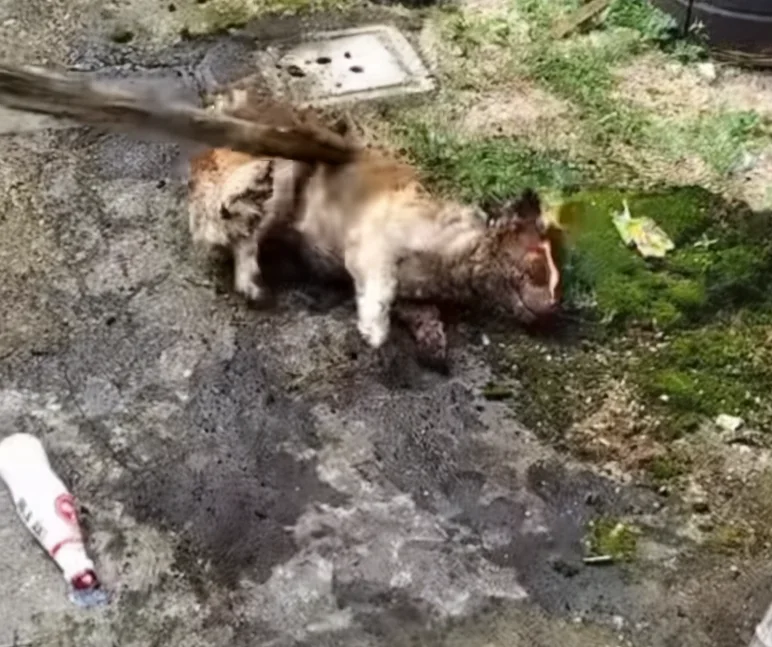
The footage went viral on Weibo, was reposted by multiple media outlets, and reached millions of people, many of whom reported insomnia, nightmares, loss of appetite, and lasting psychological distress from watching it. Petitions demanding legal accountability and national animal protection legislation began circulating internationally within days.
On June 30, the Xinheng town government issued a statement confirming that the four suspects were under the age of 14. Under Chinese law, this places them below the minimum threshold for criminal prosecution. The local government said the minors had been sent to "specialized education facilities," that their schools had been ordered to strengthen moral education, and that their parents and guardians had been urged to fulfill their supervisory responsibilities.
The statement also called on the public to stop spreading information related to the case, citing the involvement of minors, and urged people to refrain from cyberbullying.
The whole of the official response amounts to specialized education and a request that people stop talking about it.

China does not have a national animal cruelty law. There is no federal statute that criminalizes the torture or killing of animals outside of wildlife protection categories. Proposals for anti-cruelty legislation have been introduced to the National People's Congress multiple times over the past two decades without ever passing. The most recent window opened in 2026, when the Ministry of Justice launched its annual solicitation for legislative proposals, and advocates pushed to include an anti-animal-cruelty law on the agenda.
The Wangwang case landed in the middle of that push. It came weeks after a separate case in Chongqing, where a man was detained for adopting dogs under the pretense of being an animal lover, then torturing them to death in his apartment. That case, which involved an adult, generated protests in the streets. The two incidents, back to back, put the absence of legal protection into the sharpest focus it has been in since the issue first reached the NPC floor.
The advocacy letter that documented Wangwang's case was written explicitly to push for legislation. Its author lays out the facts of the killing in Mandarin and English, paragraph by paragraph, and then argues for criminal accountability and national law. The letter frames the issue as a matter of public safety in addition to animal welfare, arguing that violence which begins with defenseless animals does not necessarily end with them. The argument itself has circulated for decades; the difference this time lies in the scale of public anger, the quality of the documentation, and the footage, which left nothing to interpretation.
On July 14, 2026, a billboard appeared in Times Square, New York City. It showed Wangwang before the attack, standing over her nursing puppies, tail up, mouth open in what looks like a smile. The text read: "She was loved. She wanted to live. She should still be here."
The billboard was organized and funded by advocates working to keep Wangwang's case in public view and to maintain pressure for Chinese animal protection legislation. A case that began at the mouth of a drainage pipe in rural Guangdong is now running on a screen in one of the most heavily trafficked advertising spaces on the planet.
The four perpetrators are in specialized education, their identities have circulated widely on Chinese social media, and their school has been named publicly. Whether any of this translates into real consequence is an open question, because without a criminal statute there is nothing to charge them with and no legal framework exists to prevent the next case.
Wangwang had no home, no owner, and no legal protection; she lived at the mouth of a drainage pipe because it was the only place where she and her puppies could survive, and she was about a year old when four people who brought tools and cameras decided her family was material for entertainment. The legislative window her case landed in remains open, and updates will follow as it develops.